Wala pa ang pahinang ito sa inyong wika. Binabasa ninyo ang tekstong Ingles.
Feature
Fingerprint and its editor
- 4
- Generator generation
- 5
- Templates
- Up to 37
- Self-test lines, profile of this generation
- 114
- Countries with a clock and a language
A machine described field by field
A site reads the screen, card, cores, memory, fonts, clock and languages. No finished fingerprint is kept: it is built again at every launch.
- navigator.platform
- MacIntel
- User agent
- Mozilla/5.0 (Macintosh; Intel Mac OS X 10_15_7) AppleWebKit/537.36 (KHTML, like Gecko) Chrome/153.0.0.0 Safari/537.36
- Client hints platform
- macOS 15.1.0
- Architecture, bitness
- arm, 64
- uaFullVersion
- 153.0.7978.0
- Screen, available
- 1470x956, 1470x931
- devicePixelRatio
- 2
- WebGL vendor
- Google Inc. (Apple)
- WebGL renderer
- ANGLE (Apple, ANGLE Metal Renderer: Apple M1 Pro, Unspecified Version)
- Cores, memory
- 8, 8 GB
- Time zone
- Europe/Rome
- Languages
- it-IT, it, en
- Fonts
- 85 names, starting Helvetica Neue, Helvetica, Arial
- maxTouchPoints
- 0
- Mics, outputs, cameras
- 1, 1, 1
- Speech voices
- it only
- Connection
- 10 Mbit/s, 50 ms, 4g
- Heap old generation
- 4096 MB
- Canvas, audio seeds
- 1884544265, 3829808191
A real draw: template macOS · Chrome, profile id acct-42, engine 153.0.7978.0, no proxy. It repeats anywhere except the font list.
Identity
platform, User agent, vendor, client hints.
Screen
size, space under the menu bar, colour depth, ratio.
Hardware
WebGL vendor and renderer, cores, memory, touch, fonts.
Place
time zone, language stack, locale, country.
Devices and connection
microphones, speakers, cameras, voice locale, downlink, latency, heap.
Noise seeds
canvas seed and audio seed.
One seed for all the draws
Your profile takes the drawn values from its own id, and the draws chain because the strongest tells are pairs.
- 1
Draw the graphics card
The profile takes a vendor and renderer pair from the template's cards.
- 2
Read the cores and memory off it
A card class carries the counts it ships with.
- 3
Read the architecture off it
Apple Silicon and the mobile templates give arm, the other desktop cards x86.
- 4
Narrow the system versions
On a Mac a new chip on an old system does not turn up.
- 5
Draw the country before the clock
One throw settles clock and language together.
What a template carries
A fingerprint template is the kind of machine. A desktop profile is assembled from its parts, a mobile one is a whole device.
| Template | The machine it describes | Pick it when |
|---|---|---|
| macOS · Chrome | MacIntel, Apple Silicon or Intel graphics | the accounts were opened on a Mac |
| Windows · Chrome | Win32, NVIDIA, Intel or AMD cards | the crowd you blend into is Windows |
| Linux · Chrome | Linux x86_64, Mesa and NVIDIA renderers, no platform version | developer or hosting accounts |
| Android · Chrome (phone) | Linux armv8l, a real handset taken whole | the platform judges phones apart |
| Android · Chrome (tablet) | a real tablet, no Mobile token in the User agent | the account's history is a tablet |
Clock and language from the exit
With a proxy, the profile takes the clock and languages of the country its first exit resolves to, unless you picked them by hand.
The time zone
Intl, Date and the offset move together, and large countries carry several zones.
The language stack
The full list, because one entry beside a foreign exit is the mismatch.
The speech voices
An inventory of the system, trimmed to the profile's language when the machine has such voices.
Nothing else
Screen, card, cores and fonts stay as drawn: the account knows them.
No proxy at all
A current-generation profile draws a country by seed; older generations keep the computer's clock.
Choices instead of a text box
Under Change values you pick from lists: Screen, CPU cores, Memory (GB), Pixel ratio, Timezone, Languages, WebGL; on a phone, the Device.
Card, core and memory lists come from the generator
The profile fills an empty field itself, and a card pulls its cores and memory.
A value outside the list
You are told by name when you save, not at launch.
Cores the card never has
Laptop graphics with a workstation core count will not save.
A ratio the screen never has
No real panel has that ratio, and it will not save.
A template this generation cannot build
You are told outright, not given a phone in the card and a Mac to the site.
One generation per profile
A newer generator would hand your profiles a different computer at the next start, and that reads as a takeover.
So each profile carries its generation number and stays on it, whatever generator comes later.
Why your old profiles look unchanged
What the self-test measures
Test fingerprint: on ARMANOS Browser the self-test reads a profile as a site reads it: up to 37 lines per profile.
The values
Platform, client hints, screen, cores, memory, renderer, clock, languages.
The hiding
The automation flag reads false, patched functions read as native code.
The canvas and the card
Repeated reads agree, a graphics read agrees with the canvas, noise resists subtraction.
Other realms
An iframe and a worker answer the document's cores and platform.
Fonts
Measured as font fingerprinting works, by comparing rendered widths.
Where the substitution happens
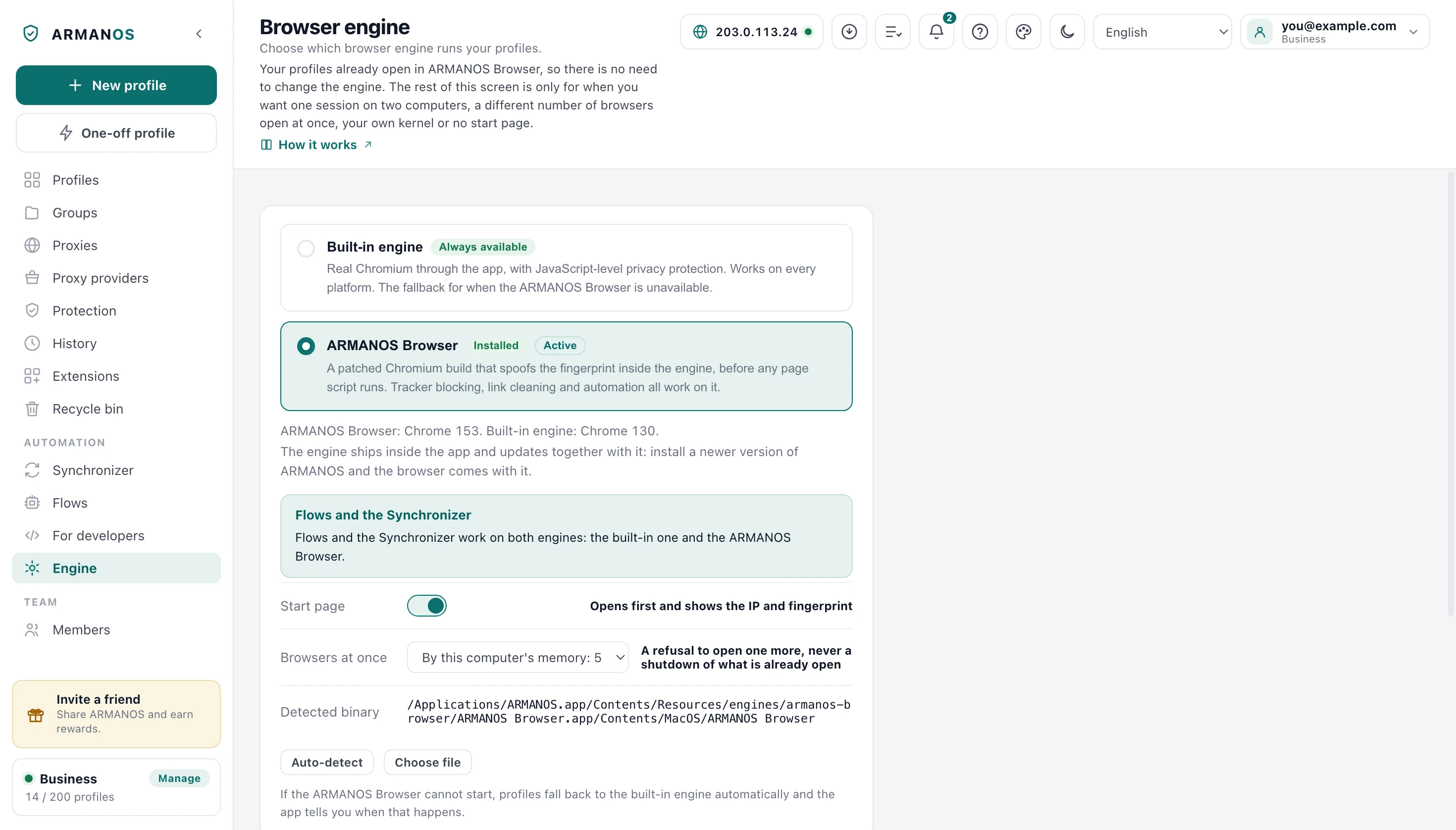
On ARMANOS Browser the fingerprint lives inside the engine, ahead of any page script. The built-in engine installs its values by script at document start.
What this does not do
- It is not a promise that accounts survive or that a profile cannot be told apart. Behaviour and account history are separate problems.
- The clock follows the exit country, not the exact city: inside a large country the zone is drawn by seed.
- Media devices are only trimmed, never invented: a computer without a camera still reports none.
- A profile from another system carries a few of your computer's fonts, or its pages render blank. A site measuring fonts sees them.
- You cannot type a fingerprint in: every editable value is a choice from a list.
- Built-in engine workers answer with the profile like the page does, except the code a new shared worker runs at start and a service worker woken with no page open. Form hints and voice names come in your computer's language. Only ARMANOS Browser covers it fully.
How to check
- One seed, and the parts agree
- packages/shared/src/index.js · apps/desktop/test/fingerprint-consistency.js
- A profile keeps its generation, an older one frozen
- packages/shared/src/fingerprint-legacy.js · apps/desktop/test/fingerprint-version.js · packages/shared/test/поколение-3-заморожено.js
- Generated cores, memory and card are all in the Change values lists
- packages/shared/src/index.js · packages/shared/test/выбор-редактора-полон.js
- The self-test runs in a real browser
- apps/desktop/src/lib/fpAudit.js · apps/desktop/test/fp-audit.js · apps/desktop/test/audit-on-builtin.js
Questions
- Why is the reported memory never above 8 GB?
- Chrome caps that number whatever the machine holds; a higher one no browser reports.
- What if the exit country cannot be resolved?
- It opens only with a confirmed country: checked now, or last time on this proxy.
- Can I type a value in by hand?
- No, there is no free text field. An odd core count gives you away harder than a generated one.
- Where does the self-test run?
- In a throwaway folder on ARMANOS Browser, in the profile's own partition on the built-in engine.
- Will an old profile get the newer draw?
- No, deliberately: a new machine under a live login is what a takeover looks like.
- Do a worker and an iframe answer the same machine?
- Yes on the ARMANOS Browser, because the substitution sits inside the engine and every realm inherits it.
See what your own browser reveals
Read your own fingerprint field by field, then compare with a profile.